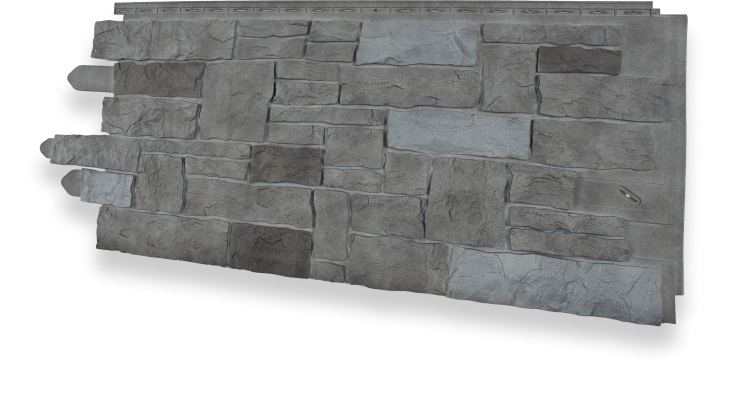




Roughsawn cedar panel
Built to outlast what nature has built for generations to come
Standard Installation
General Information
CAUTION: remember that Polymer undergoes expansion / contraction due to variations in temperature. The following instructions will allow for the expansion / contraction of the material.
1- Always begin the installation from left to right and make sure that a wall is completed before beginning a new one. Always begin at the lowest part of the structure.
2- Always hammer in the middle of fixation holes. These holes include a polymer film, which allows for precise centering of nail, allowing the expansion and contraction of material. Each complete panel must be nailed by 5 nails at maximal intervals of 16(40,6cm) or less and one nail in the lateral hole (Figure 1). If panels are installed on a furring wall, a furring strip is required behind each nail. Always use non-corrosive nails or screws with a head of 0.4(1cm) in diameter and a body of 0.150(0,38cm) in diameter and penetrate a minimum of 3/4(1,91cm) into a solid surface.
3- Never hammer the nail in completely. Leave a gap of 1/16(0,16cm) (Figure 2).
4- Make sure that all pieces are proprely joined together (Figure 3).
5- When using J-trim, leave a space of 1/4(0,64cm) between the inside wall of J-trim and the siding (Figure 4) Use standard 1(2,54cm) J-trim.
Note: To cut the material, it is recommended to use a circular saw with a finishing blade.
Installation Steps
1- To begin, install the starter strips. Make sure that the horizontal starting line is perfectly level and square with the wall. Leave a 2 1/2(6,35cm) gap at each extremity of the wall when using decorative corners (Figure A).
2- When using decorative corners, cut the left side of a panel in a straight line, insert panel into starter strip and nail the panel at 2-1/2(6,35cm) from the wall edge. When using J-trim corner, cut the left side of a panel in a straight line, insert panel into starter strip and slide it in the J-trim corner. Leave a space of 1/4(0,64cm) between bottom of J-trim and the siding (Figure B). Measure the wall length to determine where to cut your first panel in order to avoid having a very small piece at the right end of the wall. Be sure to align adjacent walls.
3- When using decorative corners, cut the left side of a panel in a straight line, insert panel into starter strip and nail the panel at 2-1/2(6,35cm) from the wall edge. When using J-trim corner, cut the left side of a panel in a straight line, insert panel into starter strip and slide it in the J-trim corner. Leave a space of 1/4(0,64cm) between bottom of J-trim and the siding (Figure B). Measure the wall length to determine where to cut your first panel in order to avoid having a very small piece at the right end of the wall. Be sure to align adjacent walls.
4- After positionning each panel at the proper spacing of the installation temperature guideline, nail in the center hole (the panel will move evenly in both directions in case of retraction or expansion). If the panel is installed on a furring wall, a furring strip is required behind this hole (Figure D). N.b. If a piece of a panel does not have the initial center hole directly in the middle, drill a new center hole of 1/8 (0,32cm) diameter at the same height as the other installation holes. each full panel should use a minimum of 6 nails.
5- Begin the second row by cutting the first panel with 16 (40,6cm) increment from the cutting line of the first row. Hooking the lower panel section with the top hooks of the last installed row. to eliminate stacking seams, alternate the cut positions for the following rows (Figure e).
6- For the last row and places where you may need to attach siding other than in installation holes at a concealed spot on the panel use a knife to create new slots 1(2,54cm); the slot must be wider than the nail but not as wide as the nail head. Although not set in installation holes, this type of cutting will allow the expansion/contraction movement (Figure F).
- If you need to set accessories on siding at a concealed spot on the panel, create a new 1(2,54cm) slot larger than the nail body but smaller than the nail head to permit expansion/contraction.
* Do not set accessories directly and only on the siding. Fasteners must be fixed on a solid surface.
Decorative Corners Installation
1- When using decorative corners, the ends of starter strips and siding panels must finish at 2 1/2(6,35cm) from the corner of the wall. To allow corner installation, nail the siding panels with a distance of 4(10,2cm) between the corner of the wall and the first nail.
2- For the bottom corner only, cut horizontally at 9(22,9cm) from the bottom (FIG.1 A). Cut the strip at the bottom of the piece that might interfere ith the starter strip (FIG.1 B). Slide the piece on the starter strips (FIG.1 C) then nail it at top and bottom («X»marks, FIG.1 B).
* Keep the remaining inferior part of the corner, it will be useful to finish the top edge of the wall.
3- The next steps of the decorative corner installation begins when two adjacent walls are completed.
4- A. The corner is ajustable as the height of the siding shingles varies. Without definitely fixing the corner, validate and adjust its position (FIG.2 A). Align the bottom end of the corner (1) with the bottom of the tiles. If the top of the corner (2) interferes with the tiles of the panels, then respect the guide of the cut-off at the back of the decorative corner and cut the surplus needed (FIG.2 B).
4- B. Insert the top of the corner under the siding panels (FIG.3 A). Fit the lower part of the corner then insert the bottom hooks into the holes of the previous upper part corner (FIG.3 B). Adjust height and fix it.
5- Repeat step 4 until the top of the wall is reached.
6- When the top of the wall in reached, use the lower part of the decorative corner that has been cut during step1 (FIG.4).
Download the installation guide
Hand-Split Shake Panel
The rugged beauty of wood made timeless without the maintenance
Warranty
Quality warranty
Novik Hand-Split Shake, Hand-Laid Brick, Hand-Cut Stone, RoughSawn & Half-Round panels are made to respond to the industry’s high standards and North America’s very strict specifications.
Opting for continuous improvements in our products, we are able to provide a transferable Limited Lifetime Warranty.
This warranty supersedes all other warranties, liabilities and obligations; whether oral, written or implied.
Terms
Novik inc. offers a warranty to the original homeowner for the replacement of any product when installed in accordance to the manufacturer’s instructions and exposed to normal weather conditions. Novik inc. also warrants that all sidings will be free from manufacturing defects. These defects include cracking, warping, peeling or excessive discoloration.
Registration and warranty transfer
This warranty will be valid only after the original homeowner completes the warranty registration form and returns it to Novik inc. along with a copy of the proof of purchase & installation contract.(See below for original owner schedule).
Coverage of the Limited Lifetime Warranty
Number of years
after installation |
Covered warranty
on prorata basis |
| 0-7 |
100 % |
| 8 |
80 % |
| 9 |
70 % |
| 10 |
60 % |
| 11 |
50 % |
| 12 |
30 % |
| 13 |
20 % |
| 14 and more |
10 % |
The warranty can only be transferred once by the original owner to an immediate subsequent purchaser (transferee). Upon this transfer, the siding will be covered under the Transferee Warranty coverage schedule and is calculated from the original date of siding installation. It is important that Novik inc. be notified of the property transfer and documentary proof of this transfer be submitted to Novik inc. to ensure coverage. (See below for transferee schedule).
Transferee schedule
Number of years
after installation |
Coverage warranty
on prorata basis |
| 0-5 |
100% |
| 6 |
80% |
| 7 |
60% |
| 8 |
40% |
| 9 |
20% |
| 10 and more |
10% |
Limitations
Noviks’ warranty does not provide protection against any damage caused by events beyond normal weather conditions, including but not limited to:
- Misuse, negligence or improper installation;
- Pollution, mildew, exposure to chemical products or inappropriate cleaners;
- Alterations to siding like painting or varnish;
- Improper handling or storage;
- Defects in material or wall in which Novik inc. siding was installed, caused by movement, cracking or setting of wall or foundation of building;
- Impact of foreign objects, hail, lightning, fire, hurricanes, tornados or any other catastrophic phenomena of nature;
- Vandalism and intentional damage.
Geographic situation, sunlight exposure, air quality and climatic factors may gradually weather the siding. If the siding is determined by Novik inc. to have faded beyond normal expectations, Novik inc. will replace defective material.
Novik inc.reserves the right to discontinue or modify any of its products without prior notice. Novik inc. shall not be liable for variations in color or gloss compared to product that has been installed and exposed to normal weather conditions.
Warranty claims
The buyer has to provide a written description of the damage and manufacturing defect together with original proof of purchase to the following address:
Novik inc.,
Customer Service Department,
160, rue des Grands-Lacs
St-Augustin-de-Desmaures (Québec)
Canada, G3A 2K1
The consumer must provide date of installation and proof of property ownership. The claimant may be required to submit a sample of the defective materials for analysis. Novik inc. will analyze the material claimed to be defective and determine the validity of the claim.
For your protection
Novik inc. siding is a very low maintenance product but is made of polypropylene. Common sense should be used to keep siding from melting or burning. It is important that all sources of heat and flames and combustible materials like dry leaves, trash, etc., be kept away from Novik siding.
If the original homeowner or transferee is shown to have neglected to provide proper maintenance to the siding, this warranty will be null and void.
Download the warranty guide (PDF | 266Ko)