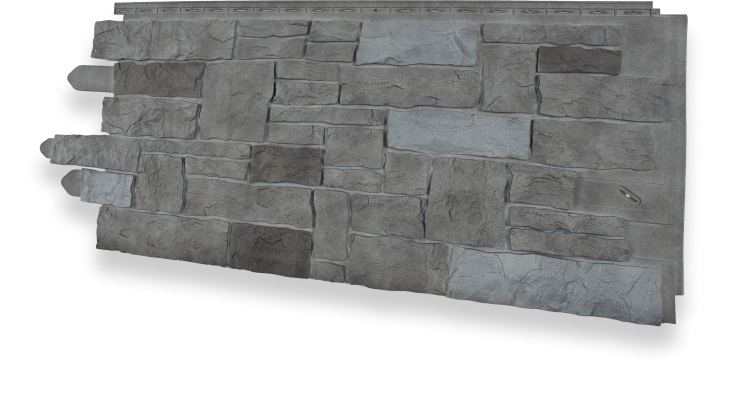




1- Always begin the installation at the lowest part of the
structure, from left to right.
2- Always hammer in the middle of fixation holes. Each complete
panel must be nailed by 5 nails at maximal intervals of 16"(40,6cm)
or less (Figure 1). If panels are installed on a furring wall, a furring
strip is required behind each nail. Always use non corrosive nails or
screws that must be able to penetrate a minimum of 3/4"(1,91cm)
into a solid surface.

3- Never hammer the nail in completely. Leave a gap of
1/16"(0,16cm) (Figure 2).

4- Make sure that all pieces are proprely joined together
(Figure 3).

5- When using J-trim, leave a space of 1/4"(0,64cm) between the
inside wall of J-trim and the siding (Figure 4).

Note:
To cut the material, it is recommended to use a circular saw with
a finishing blade.
Installation steps
1- to begin, install the starter strips at the lowest point of the
structure. Make sure that the horizontal starting line is perfectly
level and square with the wall. leave a 1 1/2"(3,81cm) gap at
each extremity of the wall when using decorative corners. if you
have a wall with a floor you must leave a gap of 1 1/4''(3,18cm)
between starter and floor. if there is no floor, the starter is flush
with the base of the wall (Figure a).

cut the left side of the panel in a straight line. insert panel
into starter strip and slide it in the J-trim corner. When using
decorative corners, place the panel at 3 1/2''(8,89cm) from the
wall edge. Measure the wall length to determine where to cut
your first panel in order to avoid having a very small piece at the
right end of the wall.
When using decorative corners: read installation instructions
for corners to ascertain proper distance of cut from end of wall.
(Figure B)

3- after positionning each panel at the proper spacing, nail in
the center hole (the panel will move evenly in both directions
in case of retraction or expansion). if the panel is installed on a
furring wall, a furring strip is required behind this hole. (Figure c)
n.B. if a piece of a panel does not have the initial center hole
directly in the middle, drill a new center hole of 1/8" (0,32cm)
diameter at the same height as the other installation holes. each
full panel should use a minimum of 5 nails.

Panel with single temperature line (Figure d.0)
4.0- install the following panel by hooking it into the starter strip
and sliding over the previous panel. Make sure that the tabs on
both sides are locked together and spaced equally. if installed at
outdoor temperature over 40 oF (5 oc), slide panel to the stoppers
(located at the rear panel). When resistance is felt, do not force
insertion of part. use the reference line to confirm the position.
if installed at outdoor temperature under 40 oF (5 oc), adjust the
panel to the temperature line indicated. (Figure d.0)

Panel with multiple temperature lines (Figure d.1)
4.1- install the following panel by hooking it into the starter
strip and sliding over the previous panel. Make sure that the tabs
on both sides are locked together and spaced equally. refer to
vertical lines that show the outside temperature the closest to
that during installation. (Figure d.1)

5- start the second row by cutting the first panel with
16''(40,6cm) increment from the cuttinf line of the first row. slide
the hooks located at the bottom of the panel into the top of the
previously installed row. (Figure e) proceed with this row and
subsequent ones following steps 3 and 4 taking care with each
new row to alternate the position of the cut on the first panel. Be
sure to finish one wall before beginning another.

6- For the last row or places where you may need to attach
siding other than in installation holes at a concealed spot on the
panel use a knife to create new slots 3/8"(0,96cm)(Figure F); the
slot must be wider than the nail but not as wide as the nail head.
although not set in installation holes, this type of cutting will
allow the expansion/contraction movement.

Decorative corners installation
7- the installation of corners begins once you have completed
two adjacent walls.
- n.B. For proper installation and optimal corner appearance,
make sure that the ends of siding panels finish at 3 1/2"(8,89cm)
from the corner of the wall and at an equivalent height.
8- For the first corner, insert the hooks into the starter strip (g.1)
and be sure to overlap the ends of each row's panels. Fold back
the top of the part toward the corner of the wall (g.2), then nail
through the oblong holes (g.3). (Figure g)

9- For all subsequent corners, insert the hooks into the openings
of the previous corner. Fold back the top of the corner toward the
wall, then nail through the oblong holes. repeat this step to the
top of the wall. (Figure H)

10- For the last corner only, cut excess from part. on each side
of the corner, make a hole wider than the shaft of the nail, but
smaller than the head. affix a nailing strip behind these locations
to fasten corners firmly. Fold back the top of the corner and nail it
down. (Figure i)

Download the installation guide